3 Reasons You Should Consider Self-Publishing Your First Book
· Storycraft and writing
Here’s how I got interested in self-publishing and 3 reasons why you should consider self-publishing your first book.
I had been working on a book about the Vietnam War for at least four years, when one of the veterans I met at a Marine Corps reunion sent me an early draft of his own work-in-progress. His war memoir was so intriguing that I dropped what I was doing to focus almost exclusively on helping him get it polished and published. Anything I learned by helping him would be applicable in my own journey, so I had no problem putting my own book on the backburner. It was refreshing to find a fellow amateur, ahead of me on the path, but on a very similar path.
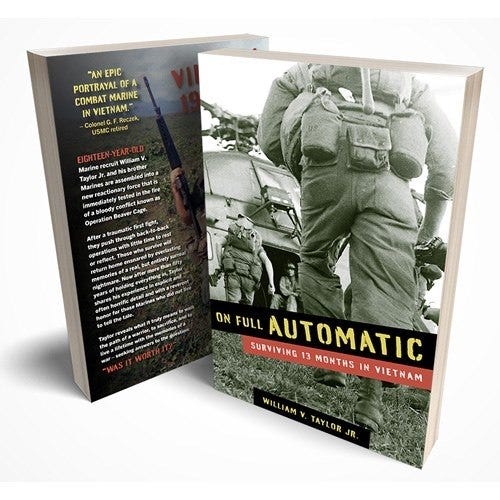
Today, that veteran, William V. Taylor Jr., is not only a dear friend, but a best-selling author. His self-published book, On Full Automatic: Surviving 13 Months in Vietnam rode the Amazon best sellers list for 63 weeks straight. As of this writing, the book has:
- 4.6 out of 5 stars and 3,883 ratings on Amazon,
- 4.6 with 1,963 ratings on Goodreads, and
- 4.8 with 140 ratings for the audiobook on Audible.
Almost three years after the book was published, he’s still averaging sales of:
- 60 paperbacks per month,
- 100 audiobooks per month, and
- 12–15,000 digital pages read on Kindle per month.
He’s now just 15,000 short of reaching 5 million digital pages read overall. If you’re as impressed at those stats as I am, then let him serve as an example of the fact that you can indeed succeed when publishing your own book.
Here are three of the benefits we learned about self-publishing, three of the reasons William chose to self-publish, and why you should consider doing it too.
1. Rights Ownership
If you choose to go with some well-established publisher, you will have to sign away all the rights to your literary work.
This includes the rights to the hardcover, the paperback, eBook, audiobook, foreign language versions, and any derivatives such as motion picture rights or related products.
William retains exclusive ownership of his book’s content across all media.
2. Total Creative Control
If you sign a contract with a publisher, you transfer all creative control to the publisher.
They can edit your book in any way they want, design a cover of their own liking (not yours), and market the book however they see fit (or worse, not at all).
William got to work closely with a designer to get a cover that fit his vision. He retains the right to “refresh” the cover design and the book, at any time, to invite new sales. He can market the book as much or as little as he wants and any way he wants. He can watch his own stats, put in his own elbow grease, and have fun experimenting with how his own creative marketing affects sales. And if he plays his cards right, he may even get to act as a consultant helping to ensure the director puts a satisfactory adaptation on the silver screen (rumor has it, a screenplay is in the works).
3. Higher Royalty Rates
Let’s face it, if you’re a new and unknown author, you’re not getting a fat advance or lucrative contract from anyone.
Whatever advance you do get will be deducted, like a loan, until your book sales have paid it back. Then, if you’re lucky, you’ll get about a $1 for every paperback sold.
William’s royalties are 60% of list price, minus the printing costs, which is at least five times what a publisher would pay. He gets an even better royalty from his audiobook.
There can be advantages to getting an agent and a publisher, but in a digital age where brick-and-mortar bookstores are on the decline, one should ask any publisher “What exactly do you bring to the table, that I cannot or that you are not already asking me to?”
Perhaps that question is better dealt with after you prove yourself, and what better way to do it than to self-publish first?
I hope this post helps you find your way.
First published on Medium on .