Patterns for PKM: Atomic Notes
Category: Processing & Development
· Personal knowledge management
🤨 What’s this pattern language thing all about? Catch up on the intro and the evolving index of patterns here.
ATOMIC NOTES
Version 2, last modified: February 22, 2025
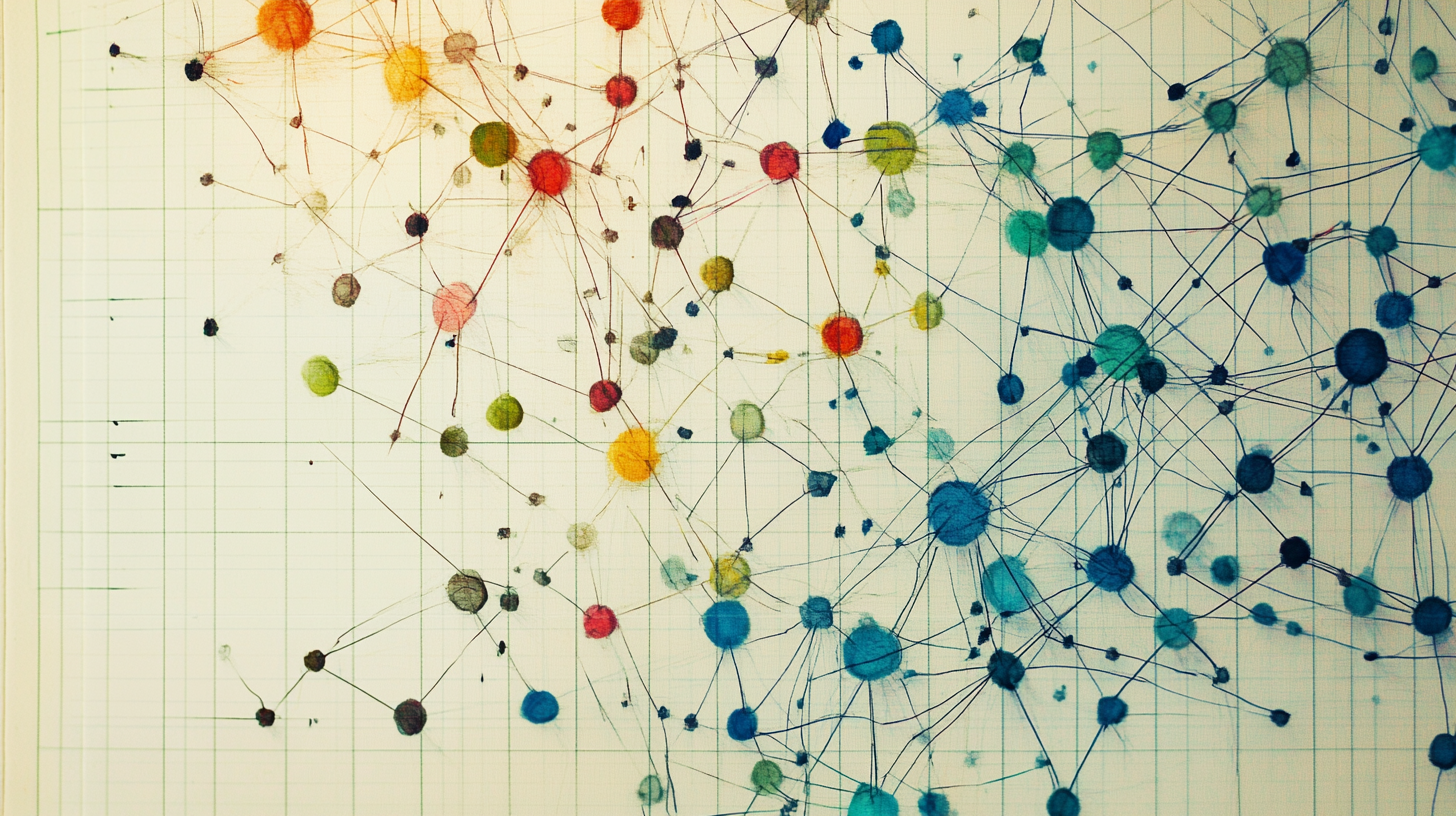
Knowledge workers struggle to capture and organize complex ideas in ways that remain useful over time. They write long, interconnected notes that become increasingly difficult to understand, maintain, and reuse. Without a clear way to break down complex thoughts into manageable pieces, their knowledge becomes trapped in dense, monolithic documents that resist both understanding and reorganization.
The deepest problem is that human understanding naturally works with discrete, interconnected concepts, but our writing habits tend toward creating large, tangled documents that mix multiple ideas together. When we try to reference or build upon these mixed notes later, we find ourselves unable to extract the specific pieces we need without losing important context or breaking connections.
We have observed that:
- People naturally think in discrete, interconnected concepts
- Understanding complex ideas requires breaking them down into simpler parts
- Knowledge becomes more valuable when it can be recombined in new ways
- Context is crucial but too much detail becomes noise
- The same idea often applies in multiple different contexts
- Connections between ideas are as important as the ideas themselves
- Writing that can’t be reused tends to be written again
- The mind can only hold one clear thought at a time
Therefore:
Write each note to contain exactly one unit of knowledge — a single concept, argument, observation, or idea. Make each note:
- Small enough to be understood at a glance (typically 1–3 paragraphs)
- Self-contained enough to make sense on its own
- Clearly titled with the core concept it contains
- Connected to related notes through explicit links
- Written in your own words to demonstrate understanding
- Focused on explaining one thing well
For example:
- A single concept: “Photosynthesis converts light energy to chemical energy”
- A single argument: “Distributed practice leads to better learning than massed practice”
- A single observation: “Desire paths reveal natural user behaviors”
- A single technique: “The Feynman Technique for learning”
- A single principle: “Gall’s Law about system complexity”
The system works because it matches how our minds naturally process and connect ideas. When each note contains exactly one clear thought, we can easily find, understand, and recombine our knowledge in new ways. The atomic structure creates natural boundaries that make both writing and retrieval easier.
Most importantly, this pattern helps establish CLEAR THOUGHT BOUNDARIES while maintaining RICH CONNECTIONS between ideas. It works together with BIDIRECTIONAL LINKING (another pattern) and supports both PROGRESSIVE SUMMARIZATION (another pattern) and EVERGREEN NOTES (another pattern).
The success of this pattern has been proven across various knowledge work contexts. Systems that implement atomic notes report:
- Improved understanding of complex topics
- Easier retrieval of specific information
- Better connection-making between ideas
- Reduced duplication of content
- More flexible knowledge organization
- Enhanced ability to synthesize new insights
- Clearer thinking and writing
- Sustainable long-term growth of knowledge
This pattern has been particularly successful in:
- Personal knowledge management
- Research and academic writing
- Technical writing
- Learning and teaching
- Project documentation
- Collaborative knowledge bases
The pattern is strengthened when combined with:
- BIDIRECTIONAL LINKING
- MAP OF CONTENT
- PROGRESSIVE SUMMARIZATION
- EVERGREEN NOTES
- ZETTELKASTEN METHOD
- CONCEPT CLUSTERING
- EMERGENCE BOARD
References
- Anatomy of an Atomic Note (Zettel) by Bryan Lee, Medium
- Atomic Note Taking by Dane Walker, Medium
- Concept and Principles of Atomic Note-Taking by Gokay BURUC
- Beyond Simple Backlinks: “Relationship” Notes as First-Class Atomic-Note Citizens by Alex Skarulis
Inspired by the Project: 4th Brain vision, Patterns for PKM is a community initiative. We don’t invent these patterns, we just help identify and collect them into a pattern language. As a valued member of our community, you’re invited to share patterns and opinions about how to improve upon those we’ve published. Want to stay in the loop?
💬 Contact me to share your thoughts and ideas
First published on Medium on .