Patterns for PKM: The PARA Method
Category: Information Capture & Organization
· Personal knowledge management
What’s this pattern language thing all about? Catch up on the intro and the evolving index of patterns here.
PARA METHOD
Version 1, last modified: Jan 29, 2025
Knowledge workers struggle with an ever-increasing volume of digital information spread across multiple tools, projects, and contexts. Their content becomes scattered and difficult to find when needed, leading to duplicated work and lost insights. Without a clear organizational framework matching how they work and think, digital content becomes increasingly chaotic and harder to manage over time.
The deepest problem is that traditional organizational systems either become too rigid (like strict hierarchical folders) or too loose (like pure tag-based systems). People need a system that balances structure with flexibility while matching their natural workflow from active projects to long-term archival.
We have observed that:
- Information naturally exists in different states of actionability
- People work primarily in projects but maintain ongoing areas of responsibility
- Knowledge value changes over time, requiring different organizational approaches
- Users need both quick access to active content and reliable archival of completed work
- Too many organizational categories create decision fatigue
- Too few categories lead to unclear boundaries and mixing of concerns
- Organization should support both action and reference
- Information’s relevance and actionability changes over time
Therefore:
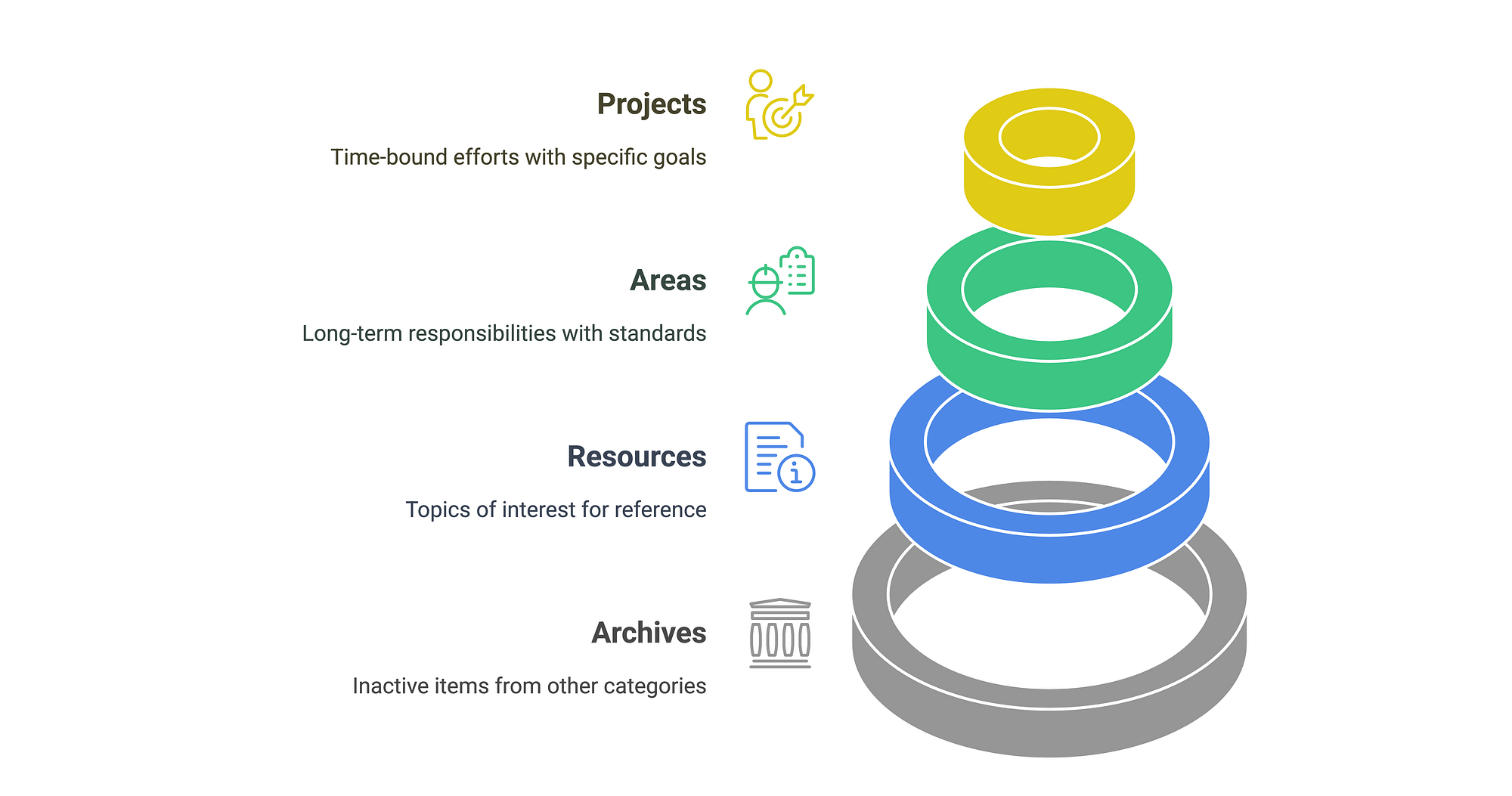
Organize all digital information into four main categories that reflect descending levels of actionability:
-
Projects (Time-bound efforts with specific
goals)
- Active initiatives with clear completion criteria
- Current focus areas requiring regular attention
- Clearly defined outcomes and deadlines -
Areas (Long-term responsibilities with standards
to maintain)
- Ongoing commitments without end dates
- Key life/work domains requiring maintenance
- Continuous activities with success standards -
Resources (Topics of interest for reference)
- Relevant topics and interests
- Reference materials and research
- Potentially useful future content -
Archives (Inactive items from other
categories)
- Completed projects
- Outdated areas
- No-longer-relevant resources
- Historical reference materials
The system works because it mirrors how we naturally think about and prioritize our work and knowledge. Projects capture our active focus, Areas maintain our ongoing responsibilities, Resources support our interests and learning, and Archives preserve our history without cluttering our active spaces.
Most importantly, this pattern helps establish CLEAR BOUNDARIES between different types of information while maintaining FLEXIBLE ORGANIZATION within each category. It works together with REVIEW CYCLES (another pattern) and supports both QUICK CAPTURE (another pattern) and PROGRESSIVE SUMMARIZATION (another pattern).
The success of this pattern has been proven across various knowledge management tools and contexts. Individuals and organizations that implement it report:
- Reduced time searching for information
- Clearer priority management
- Better project completion rates
- Maintained long-term responsibilities
- Easier archival decisions
- Improved information retrieval
- Reduced cognitive overhead
- More sustainable organization
This pattern has been particularly successful in:
- Personal knowledge management systems
- Team collaboration spaces
- Project management tools
- Research organizations
- Educational contexts
The pattern is strengthened when combined with:
- ATOMIC NOTES
- MAP OF CONTENT
- PROGRESSIVE SUMMARIZATION
- KNOWLEDGE GRAPH
- BIDIRECTIONAL LINKING
- VERSION HISTORY
- GARDEN MAINTENANCE
- KNOWLEDGE LIFECYCLE
References:
- The P.A.R.A. Method: A Universal System for Organizing Digital Information by Tiago Forte, Medium
- Building a Second Brain: A Proven Method to Organize Your Digital Life and Unlock Your Creative Potential by Tiago Forte, Amazon
- How to Organize Your Digital Life in Seconds (PARA Method) | Part 1 by Tiago Forte, YouTube
- Building a Second Brain: The Illustrated Notes by Maggie Appleton, maggieappleton.com
Inspired by the Project: 4th Brain vision, Patterns for PKM is a community initiative. We don’t invent these patterns, we just help identify and collect them into a pattern language. As a valued member of our community, you’re invited to share patterns and opinions about how to improve upon those we’ve published. Want to stay in the loop?
💬 Contact me to share your thoughts and ideas
First published on Medium on .